Perspective
The DRM Digital Radio Mondiale solution for mobile phones

Could wearables bring DRM radio to a billion cell phones?
Mobile devices with over one billion mobile phones alone are a feature of Indian life. 76 percent of radio listeners in India use their mobile devices rather than standalone sets. At the same time, free-to-air broadcast radio remains a vital public infrastructure.
Delivering mass-market DRM adoption in all frequency bands (FM included) to mobile phones – A game-changing solution
Bringing together the ease of mobile phone use and the content of free-to-air radio broadcasts can give millions of listeners from all walks of life and places access to news and general information, entertainment, sport, music, education, and emergency warnings.
“Why not just stream?” – The operators push back
Currently, for every single listener who streams a radio service via an app over Internet, the broadcaster pays content delivery network (CDN) fees (and the consumer pays data package fees), even if they are very low. As a station’s success increases, distribution costs become unsustainably high. Mobile phone/cellular networks often struggle to cope during disasters, large sporting events, and crowded festivals – and in some cases may not reach remote rural areas at all.
What is the DRM solution for mobile phones?
DRM Digital Radio services can be broadcast in the FM band (VHF Band II) for local services or in the MW and SW bands for large-area coverage from a single transmitter, providing the full digital radio feature set for listeners. This includes the state-of-the-art audio codec xHE-AAC for better-than-FM sound quality, Journaline interactive advanced text and graphics information, as well as Emergency Warning Functionality with automatic receiver wake-up/switch-over, audio announcement, and multilingual text instructions.
The new approach to enabling DRM broadcast reception in all types of mobile phones is to use everyday accessories, such as headphone cases that contain the DRM receiver chip. The wireless neckband of such a headphone acts as the natural antenna. The tuner chip captures and processes the DRM broadcast signals natively and makes them available via wireless Bluetooth to the DRM companion app running on the mobile phone. The same concept applies to the popular earbuds. The earbuds’ charging cases contain the DRM chip, which serves as the DRM receiver.
This innovative approach does not require any internal mobile phone hardware additions or design modifications, works with a wide range of mobile phones that support Bluetooth connectivity, and provides access to all DRM services not only in the FM band but also in the MW and even SW bands.
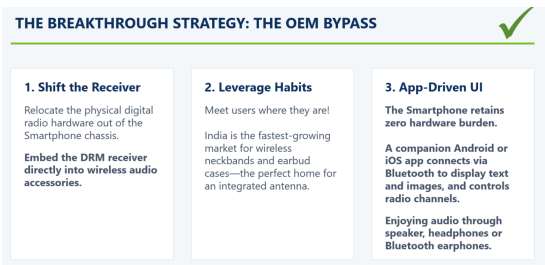
The lightweight DRM companion application on the mobile phone is available as a free download for installation. It is responsible for service selection (i.e. controlling the tuner) and displays Journaline interactive text with graphics, emergency warnings, and programme guides without using a single kilobyte of cellular data. The audio content can be accessed via the phone’s built-in speaker or connected earphones through Bluetooth or wireless connection.
This new approach allows consumers immediate access to DRM digital radio services without the need to replace or upgrade their mobile phone model of choice, merely by means of an everyday and highly affordable small phone accessory.
In short, the radio reception of the on-air signal is moved from the physical mobile phone to a wearable device (headphones, earbuds, and later other similar products). From a technical standpoint the digital radio baseband is moved out of the smartphone and embedded directly into a wireless audio accessory. The Android or iOS companion app connects via Bluetooth to control tuning and service selection, SlideShows, interactive Journaline text with graphics, and optionally outputs the audio content via the phone’s connected speaker options.
This is not about selling chips but about introducing a viable, instant, and elegant compromise: enabling DRM radio reception in the hands and ears of millions of listeners.
Enabling this revolutionary approach is a particular high-technology, but small-sized and ultra-low-power. This can be integrated into Bluetooth neckband control pods, wireless earbud charging cases, headphones, or portable speakers. The complex digital demodulation is done by the chipset outside the phone, thus sparing the smartphone’s battery. The full-featured DRM companion app will be available as a free download for installation on the mobile phone and automatically detect the DRM-enabled accessory via Bluetooth.
The cost and benefits of DRM-enabled earbuds
Today’s consumers have accepted that besides the phone they need to invest into de-bundled ear- or headphones, often with convenient Bluetooth connectivity instead of physical wires. DRM-enabled phone accessories will be available for a small add-on cost compared to the respective non-DRM version, with the mobile phone companion app available as a free download as part of the purchased DRM-enabled accessory.
This new innovative solution has several benefits.
New revenue opportunities for broadcasters
Broadcasters can consider creating their own branded mobile phone accessories along with their individually branded companion phone app.
This fits the new revenue opportunities enabled via DRM for broadcasters, such as sending occasional messages for advertising or programme notifications to the millions of Smartphone users using those devices and their custom app via the DRM feature Journaline: targeting those messages to defined sub-groups of listeners and enriching the textual/graphical ads or sponsored information with direct interactivity options (such as taking part in polls or purchasing items via web-link or phone number), leading to instant audience-engagement measurements for the broadcaster. This is a new avenue now not available to broadcasters or under the control of telco gatekeepers.
By embracing this innovative solution the Indian consumer gets a modern, premium app-driven interface on their preferred phone model they already own – complete with convenient service selection, bringing radio consumption to the convenience and accessibility levels of any major IP music streaming app, but its content fully in the hands of and controlled by the radio broadcaster.
By embedding a low-power chipset including its DRM companion app into the booming local wireless accessory market – the very neckbands and earbud cases that millions of Indians are already buying – the smartphone OEM bottleneck and hurdles are by-passed entirely, making DRM services immediately accessible to virtually all existing smartphones without requiring modifications to the actual phones.
One innovative solution – benefits for all
The new DRM in wearables solution can deliver digitisation in India on a scale it has not achieved yet in both AM and VHF bands. Apart from ease in ingenuity, this solution has clear benefits:
- For the ministry.Complete national digital radio penetration across both Android and iOS users, achieved with zero friction from global smartphone manufacturers. Ensuring free-to-air access to trusted broadcast information and national instructions in times of disaster via DRM EWF.
- For the consumer.Free, high-fidelity audio, instant access to text-based news, lifestyle updates, and educational content, and lifesaving emergency alerts delivered directly to their favorite wireless accessories withzero mobile data charges. Making radio as media-rich and convenient to access as any IP streaming app.
- For the broadcasters.Transforming the radio business with new revenue opportunities beyond the classic radio ads: By making use of Journaline for listener targeting, listener interactivity, and instant audience engagement measurements.
- For the Indian economy. A massive technological boost to domestic hardware and audio accessory manufacturers under the ‘Make in India’ initiative.
This solution can be introduced in the country straight away, as it perfectly aligns with India’s ‘Make in India’ audio manufacturing sector, allowing local brands to add a premium, highly marketable “Free Digital Radio” feature to their wireless product lines.
The game-changing solution to achieving millions of receivers is here, but one thing is required now:
Formally adopt DRM also for digitizing local FM band services, as the unified, all-band digital broadcast standard in India for mobile-peripheral integration, providing immediate broadcast services and market certainty to local accessory manufacturers.
The author is Product Director for Broadcast & Maritime, CML Micro