BCS Stories
How the broadcast industry rewrote the rulebook for FIFA 2026
The World Cup became television’s most ambitious engineering project, and its most contested rights market
The 2026 FIFA World Cup was always going to be a logistical outlier. Spread across 16 host cities in three countries, four time zones, and 104 matches, a 56-match leap from Qatar 2022, it forced broadcasters to either reinvent their production playbooks or step back from bidding entirely. Many chose reinvention. Some, especially in Asia, chose to walk away. The result is a tournament that has become as much a story about how content is made, and sold as it is about football.
The production revolution: Decentralise everything
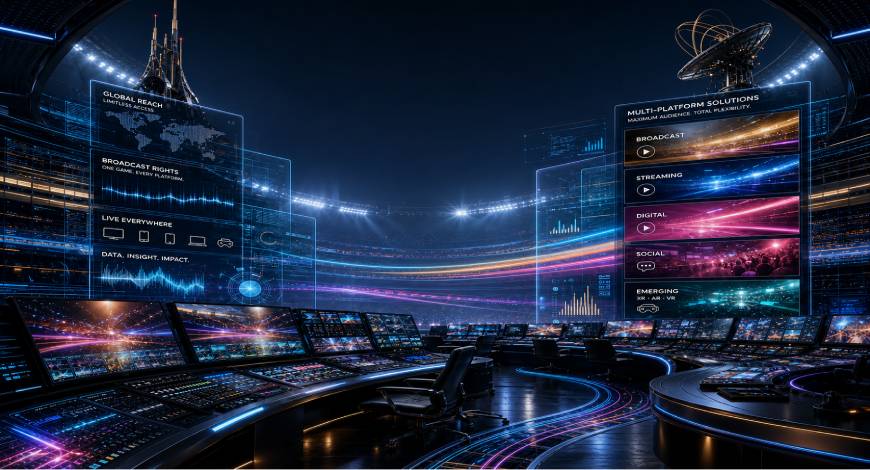
The most structurally significant shift in how FIFA 2026 is being broadcast is a concept that has been incubating in the industry for years but has never been deployed at this scale: fully decentralised remote production. FIFA’s host broadcast partner, Host Broadcast Services (HBS), anchored the entire operation around a single International Broadcast Centre (IBC) at the Kay Bailey Hutchison Convention Center in downtown Dallas, a deliberate centralisation of infrastructure to enable radical decentralisation of people.
Replay operations, audio mixing, graphics control, and camera shading for every match in the tournament are being handled by specialists sitting in Dallas, not at the stadium. The logic is elegant: the best technical directors in the world can work across multiple matches happening simultaneously without ever boarding a plane. Verizon, the official telecommunications partner, built, and is operating the broadcast contribution network connecting all venues to the IBC, delivering approximately 7 terabits per second of data capacity, a number that would have seemed fantastical a decade ago.
The underlying architecture relies on SMPTE ST 2110 networking across all sites, JPEG XS contribution workflows, software-defined processing on commercial off-the-shelf servers, and a hybrid cloud model combining private cloud capacity with selective use of public cloud. The system is IP-centric to the point where operators in Dallas work as if they were physically present at venues thousands of kilometres away. Alongside the Dallas hub, a large non-live production centre in east London handles the enormous volume of supplementary content, the 9,000 hours FIFA expects to generate across the tournament’s run.
The camera count alone tells a story: 45 cameras per match, a figure that has doubled from previous World Cups. Among them are dedicated feeds for semi-automated offside technology, which uses AI-generated 3D player avatars, players are digitally scanned on arrival, to render VAR decisions in near-photorealistic clarity. Lenovo is providing the infrastructure computing layer to support ultra-low-latency IPTV distribution alongside traditional satellite, and cable delivery.
The distribution shift: YouTube, TikTok, and the creator economy
For all the engineering complexity at the production level, the distribution story is arguably more disruptive for the long-term shape of sports media. FIFA struck what it calls “Preferred Platform” deals with both YouTube, and TikTok, the first time a World Cup has integrated social video platforms directly into the broadcast rights architecture rather than treating them as an afterthought or a piracy threat.
Under the YouTube arrangement, rights-holding broadcasters can stream select matches in full on their respective YouTube channels, and the first ten minutes of every game are available on the platform globally. This marks a fundamental shift in how football’s, governing body thinks about reach: rather than hoarding live content behind subscriptions, and pay walls, FIFA is using the world’s largest video platform as a top-of-funnel audience acquisition tool.
TikTok’s role as a preferred platform feeds into FIFA’s first-ever global creator programme, which gives selected content creators unprecedented behind-the-scenes access, accreditation, locker room access, training ground visits, in exchange for a consistent volume of short-form content. The logic is to reach younger audiences who may never watch a full match but will watch a 90-second clip 40 times.
In the United States, Fox Sports has gone further by partnering with Cosm to deliver matches, including the final, in 12K shared-reality environments — immersive venue experiences that sit somewhere between cinema, and a live broadcast. It is a bet that premium experiential viewing can command pricing that linear television increasingly cannot.
The Indian angle: A near-blackout, a bargain deal and a new broadcaster
If the production story is about ambition, the Indian broadcast story is about dysfunction, leverage, and last-minute pragmatism. For months before the tournament began, India, a market of 1.4 billion people that FIFA had publicly identified as a priority, had no broadcast deal in place. The situation was serious enough that Al Jazeera was running stories asking openly why FIFA had failed to sign a World Cup deal in one of the world’s most populous countries.
The short answer: FIFA’s valuation expectations were wildly out of step with market reality. FIFA had initially sought approximately USD100 million for a combined package covering the 2026, and 2030 World Cups. The market said no. JioStar, the joint venture between Reliance, and Disney Star that had aired the 2022 World Cup to record audiences, made a final offer of USD15 million, and walked away when FIFA refused. Even at a reduced asking price of USD60 million, there were no takers.
With less than two weeks to go before kick-off, Zee Entertainment stepped in. The company had just launched its Unite8 Sports linear channels, four of them, specifically targeting sports rights. The deal Zee signed covers the 2026, and 2030 men’s World Cups, the 2027 FIFA Women’s World Cup, and a cluster of secondary FIFA properties including U17, and U20 tournaments, Futsal World Cups, and the Intercontinental Cup through 2030. The price paid is estimated at around USD30–40 million for the full package, less than half FIFA’s original ask, and a significant discount to the USD60 million floor it had been holding at.
Coverage is running across Zee’s Unite8 linear channels, and the ZEE5 OTT platform, though the platform has not been without its own turbulence: subscription plan changes announced mid-tournament triggered user backlash, and early streaming glitches drew sharp criticism on social media. The context matters, the 2022 World Cup had delivered 32 million viewers for the final alone on JioCinema, and cumulative watch time across the tournament reached 40 billion minutes. Zee is inheriting a large audience that was watching on a rival platform, and must now migrate.
The financial picture: Record revenue, falling per-game value
For FIFA itself, 2026 represents a financial landmark. Total revenues from the four-year cycle are projected at USD13 billion, with broadcast rights accounting for approximately USD3.8 billion, a 22 percent increase on Qatar. The US rights alone, held by Fox Sports for approximately USD480 million, have risen 94 percent in value from the previous cycle.
But those headline numbers mask a more complicated picture for the industry. Analysis by Ampere Analysis shows that the per-game rights value has actually fallen by 19 percent, a direct consequence of the expanded 104-match format spreading the same total pot across 56 additional games. The total number of broadcast deals globally dropped by 11percent. In Asia, that fall was steeper: a 21 percent decline in deal volume, with regional partnership agreements collapsing from 60 to 24. China, theoretically the world’s most attractive football market, offered USD50 million for rights that FIFA had once projected could command over USD300 million.
Rising production costs are compounding the revenue pressure on rights-holders. The sheer logistical complexity of a three-country tournament, combined with the investment required in remote production infrastructure, AI tooling, and multi-platform distribution, has made the economics harder for mid-tier broadcasters, and independent producers. Several markets that previously had active independent production companies covering the World Cup found themselves either priced out or unable to justify the cost against advertising revenues compressed by unfriendly time zones.
What persists after the final whistle
The 2026 World Cup will leave several legacies for broadcast, and content production. Decentralised remote production at this scale, once proven, becomes the template for every major multi-venue sporting event that follows. The YouTube, and TikTok integration signals an irreversible blurring of broadcast rights, and social platform strategy. And the India story, a near-blackout in the world’s most populous country, averted only by a company that built four new TV channels specifically to win the rights, is a case study in how rights valuations can catastrophically misread market conditions.
The final may still be weeks away. The real broadcast story, though, is already written.