BCS’s Take
One billion screens, twenty-two languages, and the media investment thesis nobody has fully solved
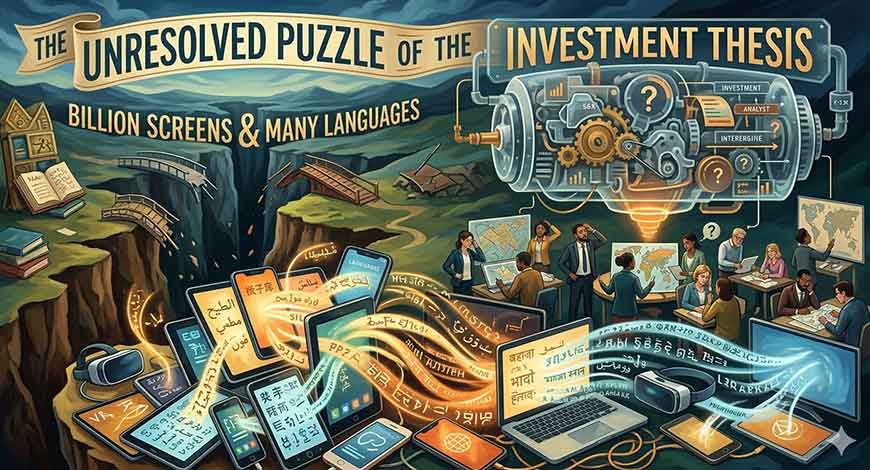
India’s digital media market is large. That much the world’s content platforms and media investors have understood for some time. What they are still working out, and what the FDI inflow data for FY 2025–26 begins to quantify, is whether “large” is the right frame at all, or whether India’s media and digital content opportunity is better understood as structurally unlike any other market that global capital has previously encountered at this scale.
India received total FDI inflows of US$58.85 billion during FY 2025–26, an 18 percent increase over the prior year, bringing cumulative inflows since April 2000 to an estimated US$1.16 trillion. Within that figure, media, digital content, and information services are identified as an emerging investment theme gaining traction among global investors, a characterization that is accurate but understates the depth of what is actually building. Rising digital consumption and the growth of India’s online economy are creating new opportunities in information and broadcasting-related sectors, including digital media and content services. That sentence does a lot of quiet work. It describes a market in structural transition, not merely a growth market.
The attention economy’s most complex frontier
What makes India’s media and digital content market genuinely singular is not its size, though that is significant, but its internal complexity. Twenty-two constitutionally recognized languages. Hundreds of dialects. Regional media ecosystems operate as largely self-contained cultural universes with their own film industries, news ecosystems, music traditions, celebrity cultures, and audience loyalties. The Tamil media market is not a subset of the Hindi media market. Telugu content consumption does not substitute for Kannada content consumption. Marathi-language streaming has dynamics that bear little relation to Bengali-language streaming.
For most of the history of global media investment, this complexity was treated as a barrier, a reason to approach India cautiously, to focus on the Hindi-speaking tier-one urban audience as a proxy for the whole, and to avoid the operational difficulty of building genuinely multilingual content businesses. That calculus is changing, for two reasons that are arriving simultaneously.
The first is mobile internet penetration reaching the population segments that speak languages other than Hindi and English at scale. The tier-two and tier-three city audiences, the regional-language-dominant users who are now the primary driver of new digital consumption growth, represent the part of India’s digital market that global platforms have historically underserved. They are now the primary growth vector.
The second is AI-driven content creation and localization, which is beginning to make it economically viable to produce, dub, subtitle, and distribute content across India’s full linguistic range in ways that would have been prohibitively expensive at human labor costs. The economics of regional-language content investment are being rewritten in real time.
The capital is reading the signal
The United States’ emergence as India’s second-largest FDI source, with equity inflows more than doubling to USD 11.17 billion, carries pointed significance for digital media. American content platforms, streaming services, digital advertising businesses, and media technology companies represent a substantial share of US outbound investment in Asia’s digital economy. The doubling of US capital flows into India in a single year is consistent with a reassessment of India’s digital media market as a primary rather than secondary priority.
Singapore’s position as India’s largest FDI source at US$19.8 billion reflects its role as the primary structuring jurisdiction for media and digital investment into India, the route through which global content companies, digital platforms, and media private equity have historically channeled capital into the subcontinent. Singapore’s FDI dominance is, in a meaningful sense, partly a proxy for global media capital’s exposure to India.
The state-level geography reinforces the media and digital content story. Maharashtra, which attracted US$18.4 billion in FDI equity inflows and retained its position as India’s top investment destination, is home to India’s film and television production infrastructure, its advertising industry, its major broadcast and publishing headquarters, and a significant share of its digital content creation ecosystem. Mumbai is to India’s media economy roughly what Los Angeles is to America’s: the production capital, the deal-making hub, the talent concentration point. Foreign investment flowing into Maharashtra is, in part, going into that infrastructure.
Karnataka’s near-doubling of inflows to US$12.9 billion tells a complementary story. Bengaluru’s technology ecosystem has produced the digital distribution platforms, content recommendation systems, ad-tech infrastructure, and streaming technology backends that India’s media economy runs on. The Global Capability Centers concentrated in Karnataka include the engineering operations of several of the world’s largest content platforms, the people building the algorithms that decide what a billion Indian users watch next.
The regulatory dimension
Media and information services sit at the intersection of investment opportunity and regulatory complexity, distinguishing them from most other FDI-receiving sectors. India’s framework governing foreign investment in broadcasting, digital news media, and information services includes sector-specific caps and approval requirements that reflect the government’s view of media as a domain with national-interest dimensions beyond its commercial value.
The targeted relaxation of Press Note 3 restrictions, which govern investment by countries sharing a land border with India, has implications that extend to digital content and information services. In an era when content platforms are global, streaming services are accessible across borders, and information services have no natural geographic boundaries, the question of which capital can enter which media segment, and under what conditions, is not an administrative detail. It shapes the competitive structure of India’s digital media market.
The broader liberalization direction in India’s FDI policy, including the 60-day fast-track approval mechanism for strategic sectors, signals a government increasingly oriented toward facilitating capital entry rather than restricting it. For media and digital content, where the investment decisions of major platforms often hinge on policy certainty as much as market size, that signal matters.
The content creation economy as investment theme
Beneath the platform and infrastructure investment story runs a creator economy narrative that the FDI statistics do not directly capture but that shapes the investment environment in consequential ways. India has developed one of the world’s largest populations of digital content creators, YouTubers, podcasters, short-form video producers, newsletter writers, and independent journalists operating in languages from Bhojpuri to Tulu. That creator ecosystem sits at the intersection of the services sector’s US$10 billion in FDI inflows and the digital media investment theme, representing a new class of media assets that conventional FDI categories were not designed to measure.
The investment implications are real. Platforms, tools, monetization infrastructure, creator funds, and the advertising technology that connects brands to fragmented creator audiences represent an increasing share of the flow of digital media capital in India. The creator economy is not an informal supplement to the formal media industry; it is increasingly the primary way that India’s non-metropolitan, non-English-speaking digital population consumes information and entertainment.
What the market has not yet priced
The DPIIT data places media, digital content, and information services in the category of emerging investment themes, sectors gaining traction rather than established recipients of major capital flows. That categorization is honest, and it implies something important: the investment thesis for India’s digital media market is not yet fully priced into the FDI figures.
The market that is emerging, multilingual, mobile-first, AI-assisted in its content production, creator-driven in its distribution, and underpinned by a domestic consumption base that is still in the early stages of digital media monetization, is larger and structurally more durable than the current investment levels reflect. The 18 percent overall FDI growth for FY 2025–26 captures a broad trend. The media and digital content story underneath it is more specific: a market with genuine structural uniqueness, at an early stage of being properly valued by global capital, which will eventually have no choice but to engage with it at scale.
BCS Bureau